Modern Kubernetes For On-Premises
Launch a fully modern, cloud-native Kubernetes platform in your own data center in just three simple steps:
1. Install the Management Appliance
Deploy the physical or virtual management appliance (Nest) in your data center. It provides the meltcloud API and runs the Kubernetes control planes.
2. Enroll Servers
Register your bare metal or virtualized servers as immutable Kubernetes worker nodes (Machines). Once enrolled, they are continuously monitored and kept up to date.
3. Manage Clusters
Provision fully managed Kubernetes control planes, attach your workers, and manage clusters cloud-style with APIs, automated updates, and on-demand scaling.
Choose Your Package
Kubernetes should fit your infrastructure, not the other way around. Explore the platform on meltcloud Public, our hosted offering, or run it in your own data center with meltcloud Private, our core product.
meltcloud Public
meltcloud, hosted by us. Bring your own worker nodes or use your Elastic Node Pool quota.
Best suited for demos, sandboxes and trials.
- Hosted by meltcloud, nothing to install
- Bring your own worker nodes (bare metal or virtual)
- Or use your Elastic Node Pool quota on compute we provide
- Sign in with GitHub or Google
- Best-effort Support
meltcloud Private
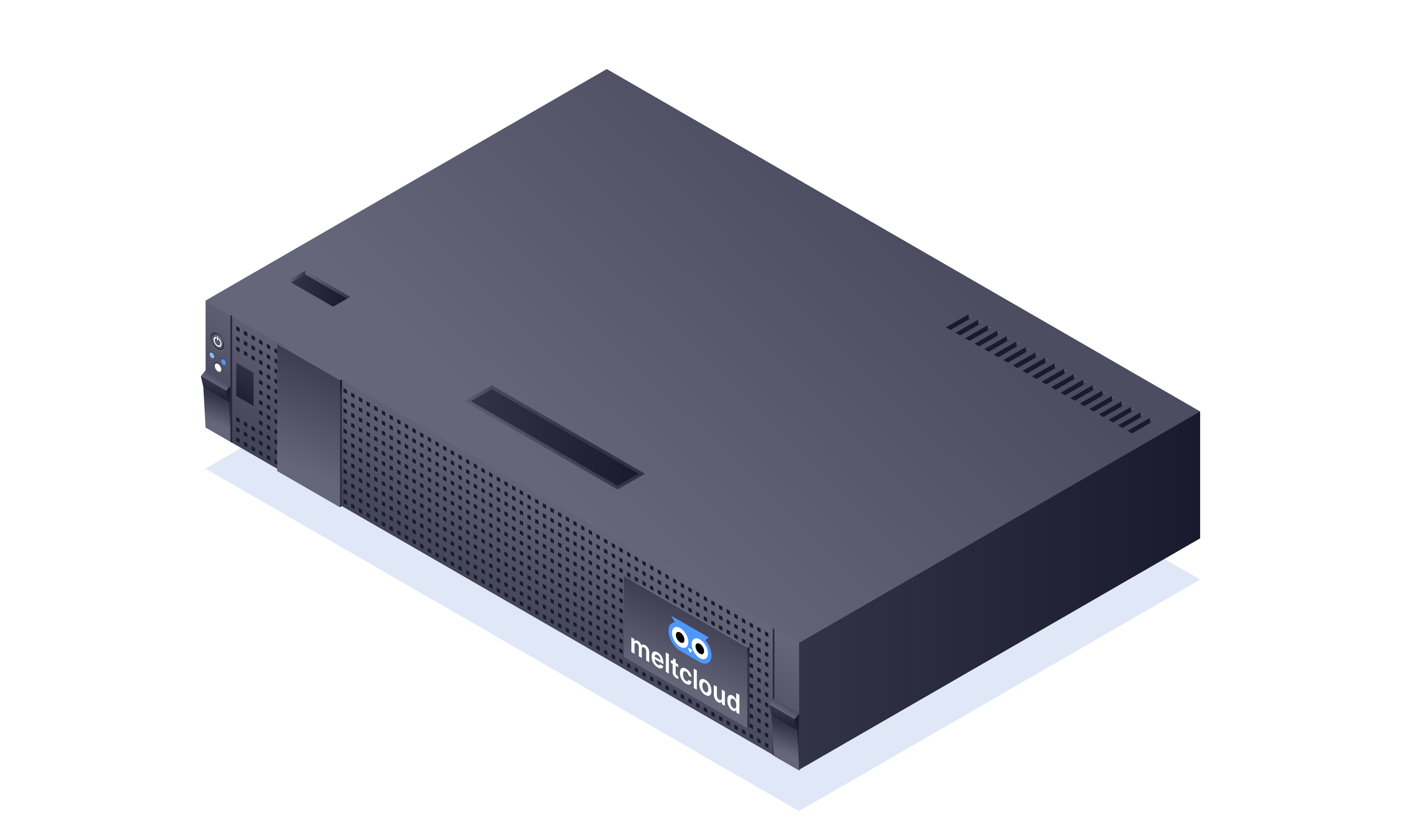
meltcloud, running in your own data center
on infrastructure you control.
Best suited for data centers and service providers.
- Runs in your data center on Nest, our physical or virtual appliance
- Control Planes and data stay on your premises, airgapped if needed
- Highly available Control Planes
- SSO integration and configurable maintenance windows
- 10x5 Support with SLA, optional 24x7
- Technical Account Manager
Where Public and Private differ
One Platform, Public or Private
Everything below is part of meltcloud, whichever way you run it.
Cloud Elasticity
Worker nodes on demand, on the bare metal you already own.
-
Slice large bare metal servers into right-sized virtual workers and share them across clusters.
-
Elastic Fleets & Quotas
Hand out CPU, RAM and disk from a shared fleet to each organization: multi-tenancy on your own hardware.
-
Autopilot Preview
Karpenter-based automatic node provisioning: worker nodes appear and disappear to fit your workloads.
Platform
-
Vanilla Kubernetes
Control planes built from upstream Kubernetes binaries, without proprietary extensions.
-
Choice of Kubernetes Minor Version
Pick the minor version per cluster; patch versions are managed for you.
-
Bring your own CNI and Storage
Clusters ship without a preinstalled CNI. Hook up existing storage arrays through CSI.
-
Virtualization with KubeVirt
Run virtual machines next to containers on the same clusters.
-
AI-ready
GPU support for AI and machine learning workloads.
-
Terraform Provider & API
Manage everything as code. New features are supported in Terraform at launch.
-
Model racks and data centers as failure domains; nodes get the matching topology labels.
-
Enterprise-Level RBAC
Role-based access for your organizations and teams.
Managed Control Planes
-
Unlimited clusters. Control planes run containerized instead of occupying whole servers.
-
Monitoring & Self-Healing
Control planes are monitored around the clock and recover on their own.
-
Automatic Scaling
The Kubernetes API scales with the load of each cluster.
-
Automated Patch Updates
Kubernetes and etcd are kept on the latest patch version.
-
You decide when. Version skew checks keep control plane and workers compatible.
-
Certificate & Secret Rotation
Certificates, bootstrap tokens and kubeconfigs are rotated automatically.
-
kubectl Access via OIDC
Users authenticate against the cluster with their own identity.
-
Backup & Restore
Scheduled etcd backups to S3, plus backup and restore on demand.
Managed Machines
-
Unlimited Worker Nodes (Machines)
Anything that boots a Linux ISO can become a worker: bare metal or virtual.
-
Immutable & Hardened OS
A minimal, stateless operating system based on Flatcar Container Linux.
-
Automated OS & Kubelet Updates
Fresh machine images regularly, applied in maintenance windows.
-
Rolling Updates
Machines are cordoned, drained, rebooted and rejoined one after another.
-
Group machines into update domains, for example canary and production.
-
Boot the enrollment image from USB, BMC virtual media or UEFI HTTP Boot.
-
Bonds, LACP and VLANs to fit your existing switching fabric.
-
Networks, Subnets & IP Pools
Model your network layout and let meltcloud assign the addresses.
Why meltcloud?
Managing Kubernetes shouldn't feel like a full-time job. meltcloud takes care of provisioning, scaling, self-healing and updates so you can spend your time enabling developers instead of maintaining infrastructure. With security, observability, and self-service built in, you get a reliable cloud-like Kubernetes experience on-premises.
-
Vanilla Kubernetes, no proprietary extensions or restrictions
-
Instant, flexible and self-service Kubernetes clusters
-
Fully automated lifecycle & self-healing, orchestrated via API
-
Seamless support for both containers and VMs
Tired of the complexity of running on-prem infrastructure? meltcloud gives you the same automation and ease you expect from the public cloud, but in your own data center. Spin up Kubernetes in minutes on any hardware, manage VMs and containers side by side, and enforce enterprise-grade security without the manual work.
-
Deploy and manage Kubernetes clusters effortlessly
-
Ensure stability with automated lifecycle management
-
Run on bare metal for maximum performance and efficiency
-
Enhance security with an immutable OS and built-in compliance
Public cloud offers speed, but at the cost of control. Traditional infrastructure offers control, but at the cost of agility. meltcloud gives you both. Get a fully automated, cloud-native Kubernetes platform that reduces operational overhead, lowers costs, and ensures data sovereignty. Let your teams focus on innovation, not infrastructure.
-
The foundation for the Cloud Native Data Center - Enterprise-grade Kubernetes, without complexity
-
Cost-efficient on-premises alternative to public cloud or complex, high-effort solutions
-
Full control over infrastructure and data sovereignty
-
Faster time-to-value with automated operations
Frequently Asked Questions
We'll happily onboard you to meltcloud Public with a trial account, so you can get your hands dirty in short time.
You can enroll virtual machines the same way as bare metal servers. Be aware that for some use cases (i.e KubeVirt, Elastic Node Pools), we require running on the metal, so we recommend building on hardware directly.
We've designed our setup to integrate nicely into existing network architectures. We support the most common enterprise networking features like bonds, LACP and VLANs out of the box, so it should fit right in.
Yes, we recommend using your existing storage arrays. FibreChannel, iSCSI or NFS: As long as it offers a CSI plugin, we can support it.
We enroll our own tested, immutable operating system images based on Flatcar Linux. They are as minimal as
possible,
while still providing all drivers and services to integrate into enterprise systems (NFS client, iSCSI
initiator, multipathd, nvidia drivers, ...).
We currently don't support other operating systems.
We provide regular updates for all involved components (control planes, worker nodes, management appliance) via automated release channels. We gracefully rollout updates to your system during maintenance windows that are configurable.
No, we don't aim to become a full-fledged Application platform. We aim to provide a rock-solid cloud-like Kubernetes distribution where platform teams can build their custom platforms on top.
OpenShift is a perfect fit for enterprises that want the full depth of a standardized, opinionated
enterprise platform.
However, there are many platform teams that just want to build their own platform on top of a managed
kubernetes layer - this is who we build meltcloud for. It‘s like GKE/AKS/EKS they know from the cloud,
just for their own hardware.
We are big fans of Talos Linux und really like how Sidero reinvented Operating Systems for Kubernetes.
However, managing the OS is just one problem to solve when building up Kubernetes estate in a company.
Other hard problems - most notably how to use a pool of static, big bare metal nodes to host a dynamic
number of control planes and worker nodes - has yet to be solved by the industry.
meltcloud is our way of addressing these challenges in a practical, integrated package.
We believe that patching nodes, tweaking bonds, and nursing etcd back to life shouldn't use up time of your smartest engineers. We aim to automate the low-level plumbing while your team spends their time building the platform your organization needs.
We generally don't recommend lifting and shifting entire VMware environments into KubeVirt:
While KubeVirt builds on proven technologies like KVM and integrates tightly with Kubernetes, it is not intended to serve as a one-to-one replacement for traditional virtualization platforms.
KubeVirt shines when you want to manage virtual machines in a cloud-native way: declaratively, with automation, and alongside the same workflows you already use for containers.
This approach lets you run virtualized workloads today, start small and gradually modernize while your teams build the necessary expertise. Over time, you can decrease your dependence on legacy virtualization and realize the full advantages of a modern, unified Kubernetes foundation.